



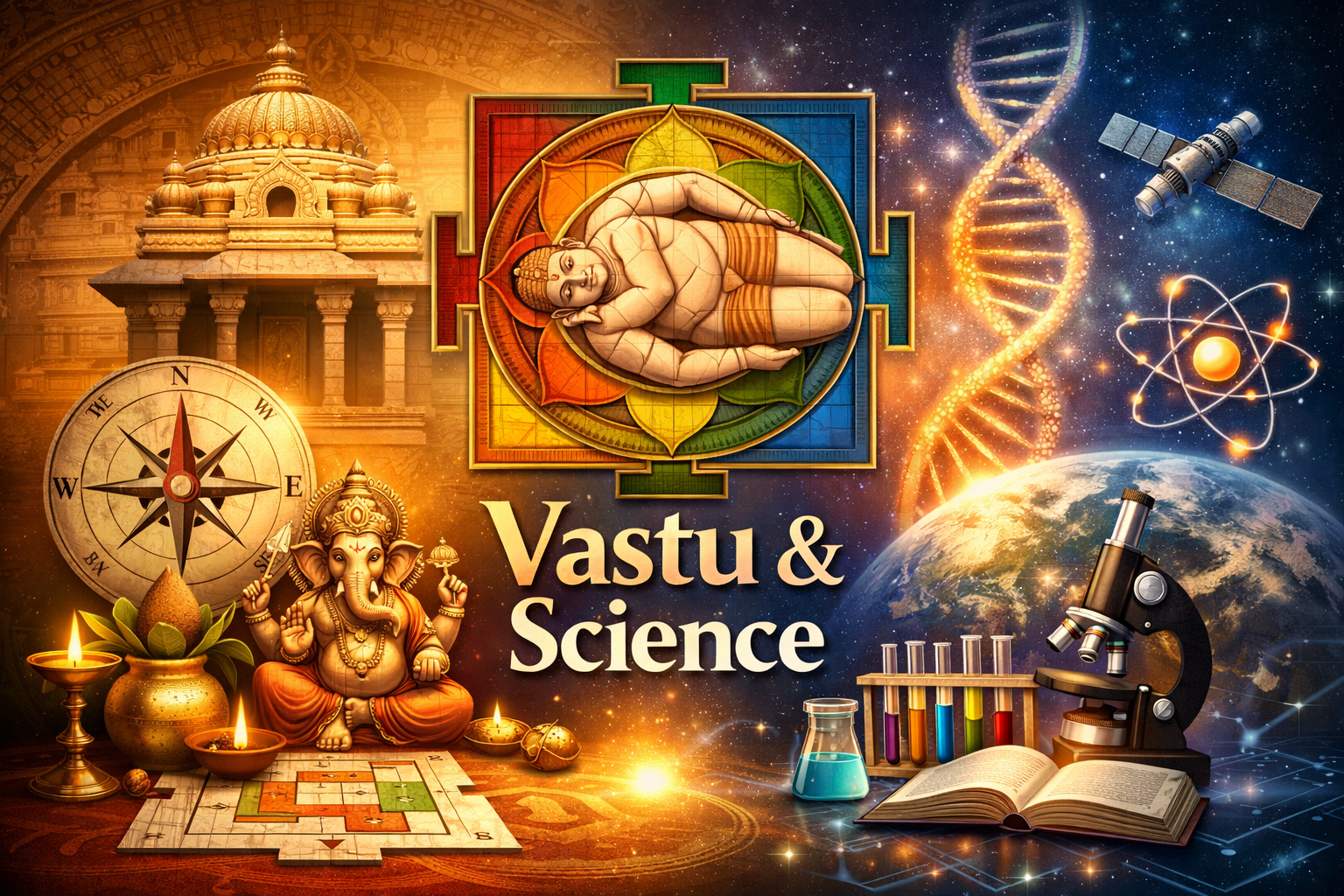
Vastu Shastra is not merely a collection of ancient beliefs but a well-structured science that incorporates principles of architecture, astronomy, astrology, and physics. Modern research has begun to validate many Vastu principles, revealing that they are based on scientific understanding of natural forces, environmental factors, and their profound impact on human health and well-being.
Ancient Vastu sages were keen observers of nature. They understood the movement of the sun, Earth's magnetic field, wind patterns, and the behavior of the five elements. Their observations, refined over millennia, created a comprehensive system for designing spaces that work in harmony with natural forces rather than against them.
Today, fields like environmental psychology, bioelectromagnetics, and chronobiology are validating what Vastu practitioners have known for thousands of years – that our built environment profoundly affects our physical health, mental clarity, and spiritual well-being.
Represents magnetic and gravitational forces. The stability of structures depends on proper grounding and foundation – a principle validated by modern civil engineering and geotechnical science.
Represents the liquid state essential for life. Vastu's water placement rules align with hydrology principles for proper drainage, moisture control, and natural water table gradients.
Represents energy and transformation. Southeast kitchen placement optimizes natural ventilation and fire safety – principles supported by modern architectural science and building codes.
Represents the gaseous state and movement. Cross-ventilation principles in Vastu are now standard in sustainable architecture, validated by HVAC engineering studies.
Represents cosmic energy and electromagnetic waves. The Brahmasthan (center) concept relates to energy distribution – validated by studies on electromagnetic field patterns in structures.
When all five elements are in balance, they create optimal conditions for health and prosperity. Imbalance leads to disharmony – a principle also seen in traditional Chinese medicine and Ayurveda.
Vastu's orientation principles maximize natural heating and cooling, reducing energy consumption – now a cornerstone of green building design and LEED certification.
Vastu's emphasis on plants, water features, and natural elements aligns with modern biophilic design principles proven to reduce stress and boost productivity.
Heavy Southwest construction provides stable foundations and protects against prevailing winds – validated by structural engineering principles and seismic design codes.
Maximum openings in East and North optimize natural light while minimizing heat gain – a key principle in modern sustainable architecture and energy efficiency.
Get expert Vastu consultation based on scientific principles for your home or office.
Book Consultation